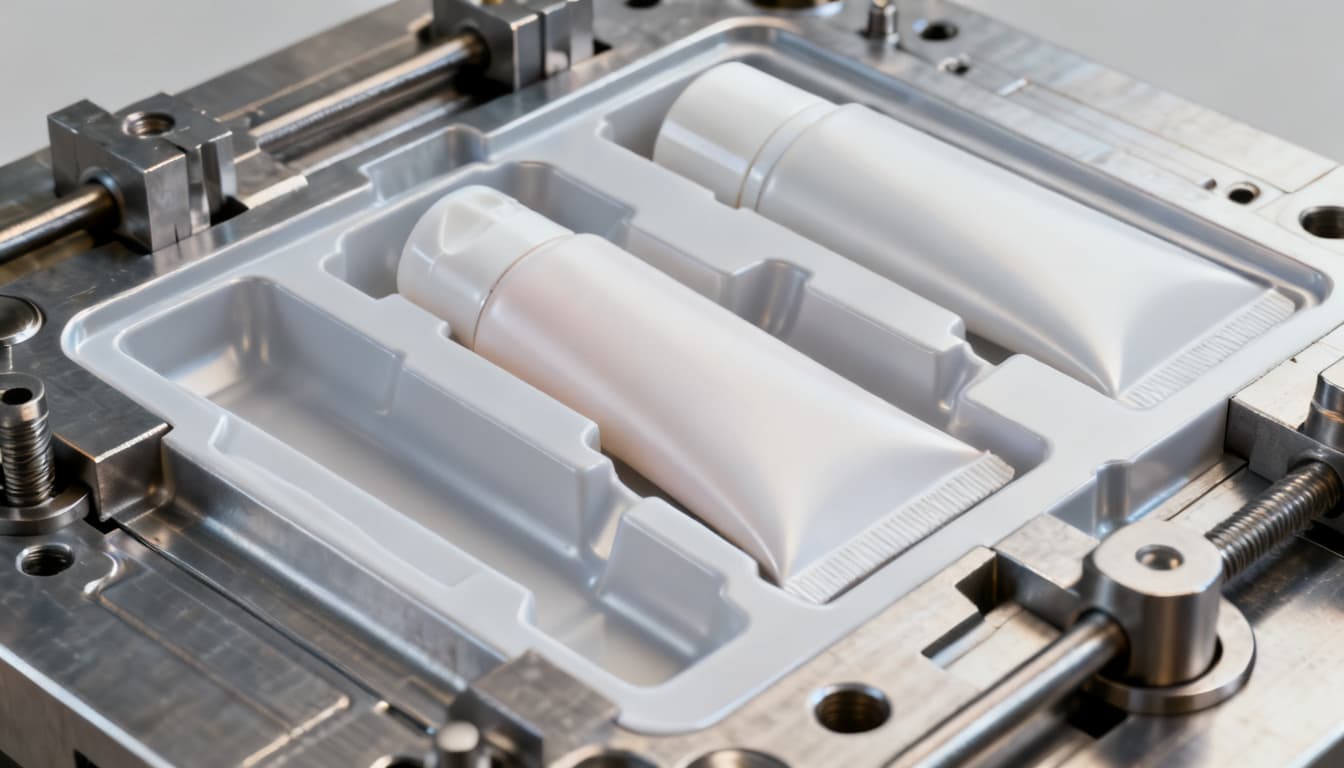
Eliminating Gate Blush and Flow Lines in Health & Beauty Packaging: A Troubleshooting Guide for Molding Partners
For years, a faint cloudy halo around the gate of a lipstick cap or a subtle flow line on a compact case was treated as a negotiation point between the molder and the brand’s quality team—a cosmetic blemish that might be accepted with a concession. That era is ending. The regulatory landscape for co
Eliminating Gate Blush and Flow Lines in Health & Beauty Packaging: A Troubleshooting Guide for Molding Partners
Why Gate Blush Is No Longer Just a Cosmetic Flaw in Beauty Packaging
For years, a faint cloudy halo around the gate of a lipstick cap or a subtle flow line on a compact case was treated as a negotiation point between the molder and the brand’s quality team—a cosmetic blemish that might be accepted with a concession. That era is ending. The regulatory landscape for cosmetics packaging is shifting rapidly, and surface defects like gate blush and flow lines are now entangled with mandatory recall authority, sustainability claims, and consumer perception of product safety.
In December 2025, the FDA issued draft guidance on mandatory cosmetics recalls under the Modernization of Cosmetics Regulation Act (MoCRA), giving the agency clear authority to compel recalls when a cosmetic product is adulterated or misbranded (FDA Cosmetics News & Events). While the guidance does not explicitly regulate injection molding defects, it creates a framework where packaging that appears contaminated, cracked, or otherwise compromised can trigger a recall. A gate blush that resembles a stress crack or a jetting swirl mistaken for material degradation is no longer just a quality issue—it’s a potential regulatory trigger. The FDA’s public recall database already shows an increase in cosmetic product withdrawals where packaging integrity and visual defects are cited as contributing factors (FDA Recalls & Safety Alerts).
Simultaneously, the proposed Packaging and Claims Knowledge (PACK) Act of 2025 aims to standardize sustainability claims across the U.S. (Cosmetics & Toiletries, “Beauty Under Fire”). A beauty brand that markets its compact case as fully recyclable cannot afford a visible flow line that consumers interpret as a material flaw undermining the product’s premium or eco-friendly positioning. In this environment, molders serving health and beauty brands must treat gate blush and flow lines as first-order production risks—not just aesthetic annoyances.
The Shear Science Behind Blush, Jetting, and Flow Lines in High-Gloss Parts
Gate blush is not a single defect but a family of surface anomalies rooted in how the polymer melt behaves as it passes through the gate and enters the cavity. In high-gloss beauty packaging—think transparent ABS caps, PC bottles, or PPO compacts—these defects are especially visible and unforgiving. Understanding the shear physics is the first step to eliminating them.
When melt flows through a constricted gate at high velocity, the polymer chains experience extreme shear rates. The outer layer of the melt can fracture, creating a cloudy, milky appearance known as gate blush. If the gate is too small and injection speed too high, the melt can jet into the cavity as a snaking stream that cools before fusing with the rest of the material, producing wormlike swirls called jetting (NexPCB, “How to Avoid Jetting and Gate Blush”). Flow lines—often described as orange peel or wavy ripples—occur when the melt front cools too quickly and folds over itself, typically due to low melt temperature or insufficient fill speed (Protolabs, “Cosmetic Appearance on Injection-Molded Plastic Parts”). Concentric flow rings around the gate are a hallmark of high-shear gate designs, particularly edge gates fed by trapezoidal runners (PlasticsToday, “What Caused the Blush?”).
The table below maps each defect to its primary root cause and the materials most often affected in beauty packaging, with inline references to the technical literature.
| Defect | Appearance | Primary Root Cause | Typical Materials Affected | Reference |
|---|---|---|---|---|
| Gate Blush | Cloudy, milky halo around gate | Excessive shear due to undersized gate or high injection speed | ABS, PC, PPO, transparent grades | PlasticsToday, NexPCB |
| Jetting | Wormlike swirl, snake-like marks | High-velocity melt jetting into cavity without controlled flow front | All thermoplastics, especially with cold gates | Plastics Technology |
| Flow Lines / Orange Peel | Wavy, rippled surface texture | Melt temperature too low, fill speed too slow causing premature solidification | High-gloss ABS, PC/ABS blends | Protolabs |
| Flow Rings | Concentric rings around gate | High-shear gate causing melt fracture, or intermittent flow | ABS, PC | PlasticsToday |
Key takeaway: In beauty packaging, these defects rarely appear in isolation. A gate that is too small can cause blush and jetting simultaneously, while a cold mold may produce flow lines that exacerbate the visual impact of a faint blush. The processor’s job is to identify the dominant mechanism and tune the process or gate geometry accordingly.
Gate Configuration Trade-Offs for Flawless Cosmetics Surfaces
Gate design is the single most influential factor in determining whether a high-gloss beauty part will exhibit blush, jetting, or flow lines. The choice between an edge gate, sub gate, or valve gate involves a trade-off between tooling cost, maintenance, and the achievable cosmetic quality. Drawing on troubleshooting guides from NexPCB and AIM Processing, as well as case studies from PlasticsToday, the table below compares the three most common gate types used in health and beauty packaging.
| Comparison Metric | Edge Gate (Trapezoidal Runner) | Sub Gate (Cashew/Tunnel) | Valve Gate (Hot Runner) | Selection Criteria & Failure Boundary |
|---|---|---|---|---|
| Blush Risk | High – sharp corner and small land create high shear | Medium – if radiused and properly sized, can reduce shear | Low – controlled opening eliminates frozen skin | Edge gates are notorious for blush in transparent ABS; valve gates are the gold standard for high-gloss caps. |
| Jetting Risk | High if gate too small | Low if melt flows into cavity smoothly | Very low – melt front controlled | Jetting occurs when the gate acts as a high-velocity nozzle; sub gates naturally direct flow against a cavity wall, reducing risk. |
| Tooling Complexity | Low | Medium – requires ejector pin actuation or angled tunnel | High – requires hot runner manifold and valve pin control | For 16+ cavity beauty packaging, valve gates often pay back through reduced scrap and faster cycle times. |
| Maintenance | Simple | Moderate – gate vestige may wear | Requires regular valve pin and heater maintenance | Sub gates may need periodic re-polishing; valve gates need monitoring of pin seating and heater performance. |
| Suitability for Transparent ABS | Poor – blush highly visible | Good if gate vestige is hidden and land is generous | Excellent – minimal gate mark, no blush if properly profiled | The PlasticsToday article “What caused the blush?” notes that edge gates fed by trapezoidal runners are particularly problematic for cosmetic parts. |
The PlasticsToday case study (“What Caused the Blush?”) illustrates this trade-off vividly: a molder struggling with blush on an edge-gated part saw a 100% improvement simply by switching to a lower-shear gate configuration and adjusting melt temperature. For high-cavitation beauty tools, many molders now default to valve gates with sequential control to eliminate flow rings and blush entirely, even if the upfront tooling cost is higher.
Processor’s Checklist: Tuning Parameters to Erase Blush and Flow Lines
When a multi-cavity beauty tool is already cut and producing parts, rebuilding the gate is not always an option. The following checklist distills the most effective process adjustments, ranked from least invasive to those requiring tool modifications. Each recommendation is grounded in published processing studies from Plastics Technology and Protolabs.
- Profile the injection speed. Start with a slow velocity through the gate (typically 10–30 mm/s for ABS) until the melt front is established, then ramp to the main fill speed. This eliminates the high-shear spike that causes blush and prevents jetting. Use cavity pressure sensors to verify that the flow front remains continuous.
- Raise melt temperature within the material’s safe window. Increasing melt temperature by 5–15°C reduces viscosity and shear stress at the gate. For ABS, a melt temperature of 230–250°C often resolves blush without causing degradation, as demonstrated in the PlasticsToday Part 44 article (“Predictability of Gate Blush”) where lowering heat had previously caused screw slippage, but a modest increase eliminated blush.
- Increase mold temperature. For high-gloss parts, a mold temperature near the material’s glass transition temperature (e.g., 80–100°C for ABS) keeps the melt from freezing prematurely, reducing flow lines and orange peel. This will extend cycle time, so consider conformal cooling to offset the impact.
- Modify gate land length. If the gate land is too short, the shear rate spikes. Extending the land by 0.5–1.0 mm provides a gentler transition and reduces blush. This is a relatively simple EDM modification that can be performed without re-cutting the entire gate.
- Enlarge the gate orifice. For a 0.5 mm gate causing blush on an ABS cap, opening it to 0.8 mm can lower the shear rate below the critical threshold. The trade-off is a larger gate vestige, which may require a secondary trimming operation—often unacceptable for luxury packaging. Use mold flow simulation to find the minimum diameter that avoids blush.
- Implement sequential valve gating. On hot runner tools, program valve pins to open in sequence. Delaying the gate opening until the flow front from an adjacent gate has passed prevents flow rings and knit lines. This technique allows fast overall fill speeds while maintaining a controlled melt front, directly addressing the cycle time vs. quality conflict.
The table below summarizes the key process parameters and their effects, providing a quick reference for troubleshooting on the shop floor.
| Parameter Adjustment | Effect on Blush/Flow Lines | When to Use | Cautions |
|---|---|---|---|
| Profiled injection speed (slow-fast) | Eliminates shear spike at gate, prevents jetting | First response to any blush or jetting defect | Too slow a profile can cause flow lines in thin walls; use pressure sensors to optimize transition point |
| Melt temperature +5–15°C | Reduces viscosity, lowers shear stress | When blush persists after speed profiling | Excessive temperature risks material degradation, splay, and longer cooling time |
| Mold temperature near Tg | Delays freezing, smooths flow lines | Orange peel or flow lines on high-gloss surfaces | Increases cycle time; balance with conformal cooling or reduced cooling time if packing is optimized |
| Gate land length +0.5–1.0 mm | Reduces shear rate at gate | Blush localized exactly at gate, no jetting | Too long a land increases pressure drop; verify with simulation |
| Gate diameter increase (e.g., 0.5 to 0.8 mm) | Lowers shear rate, eliminates blush | When simulation confirms shear rate exceeds material limit | Larger vestige; may require post-mold trimming; not suitable for visible surfaces without secondary ops |
| Sequential valve gating | Controls melt front, eliminates flow rings | Multi-cavity hot runner tools with flow ring issues | Requires individual pin control; higher upfront cost and maintenance |
Tip: Before modifying steel, run a simple design of experiments (DOE) varying injection speed and melt temperature. In many cases, you’ll find a process window where both blush and flow lines disappear. Document that window and use it to establish an agreed aesthetic boundary sample with the brand.
Health & Beauty Molding Partners Ask: Gate Blush and Flow Lines FAQ
Q: How do I convince a beauty brand that a faint flow line is process-related and not a mold defect?
Show data from a mold qualification DOE that varies fill speed and melt temperature. The Protolabs cosmetic appearance guide (Protolabs) provides a classic example: lowering injection speed eliminated orange peel but introduced gate blush, proving the defect is parameter-dependent. Run the tool at the extremes of the process window to demonstrate that the flow line appears and disappears with process changes, then align on an aesthetic boundary sample that defines the acceptable limit. This approach shifts the conversation from “the mold is wrong” to “we have a validated process window.”
Q: Can we predict gate blush during mold flow simulation, or is it always trial and error?
Modern simulation software can predict high-shear regions and jetting risk if gate geometry and material rheology are accurately modeled. However, predicting blush specifically still requires correlating simulation shear rates with physical trials. The PlasticsToday Part 44 article (“Predictability of Gate Blush”) notes that while simulation flagged the problematic gate, the final solution came from empirical tuning of melt temperature. A well-tuned simulation will identify gates with shear rates exceeding the material’s critical limit, allowing you to resize or reconfigure the gate before steel is cut—but always plan for a physical validation step.
Q: What is the fastest way to eliminate gate blush on an existing multi-cavity beauty tool without rebuilding the gate?
First, profile injection speed: slow through the gate until the melt front is established, then ramp up. Next, raise melt temperature 5–10°C to reduce viscosity at the gate, but stay within material degradation limits. If blush persists, consider a tab or extended land modification—often a less invasive fix than re-gating. The NexPCB troubleshooting guide (NexPCB) highlights that simply enlarging the gate land or adding a small radius can dissipate shear without a full gate rebuild. For multi-cavity tools, verify that all cavities exhibit the same defect; uneven filling can cause cavity-to-cavity variation that mimics a gate issue.
Q: Which gate type is least likely to blush in transparent ABS cosmetic caps?
A valve gate with a properly sized orifice and controlled opening profile usually produces the least blush because it eliminates the frozen skin and high shear of cold sprue/edge gates. For ABS, a sub gate with a generous radius can also work, but edge gates fed by trapezoidal runners are notorious for blush, as detailed in the PlasticsToday article (“What Caused the Blush?”). If a hot runner system is not feasible, a well-designed sub gate that directs flow against a cavity wall and uses a radiused land is the next best option.
Q: How do I balance a fast cycle time demanded by beauty brand pricing with the slower fill speeds needed to prevent flow lines?
Use a profiled injection speed: fast fill in thicker sections, slow through the gate and near thin cosmetic walls. Hot runner systems with sequential valve gating allow you to fill rapidly while controlling the melt front to avoid flow lines. The key is to optimize cooling time—often a bigger lever than fill time—so that the overall cycle does not suffer. The Plastics Technology article on cosmetic defects (Plastics Technology) emphasizes that a slightly slower fill can be offset by a higher mold temperature and efficient cooling design, maintaining cycle time while delivering a flawless surface.
Q: Are there specific FDA or MoCRA requirements that make gate blush a compliance issue in cosmetics packaging?
While MoCRA and the FDA’s mandatory recall guidance do not directly regulate surface defects, they require that packaging not compromise product safety or mislead consumers. A gate blush that looks like contamination or a crack can trigger a recall if consumers perceive it as a product defect. The FDA’s draft guidance on mandatory cosmetics recalls (December 2025) (FDA Cosmetics News & Events) and the PACK Act’s sustainability claims standardization mean that any aesthetic defect that undermines perceived quality or recyclability claims can become a legal and commercial liability. In practice, beauty brands are already writing cosmetic surface specifications into their supplier quality agreements, making gate blush a contractual as well as a regulatory concern.
References & Further Reading
- FDA Cosmetics News & Events – Draft Guidance on Mandatory Recalls
- FDA Recalls, Market Withdrawals, & Safety Alerts
- Cosmetics & Toiletries – Beauty Under Fire: Why 2026 Will Be a Pivotal Year
- PlasticsToday – The Troubleshooter: What Caused the Blush?
- PlasticsToday – The Troubleshooter, Part 44: Predictability of Gate Blush
- NexPCB – How to Avoid Jetting and Gate Blush
- AIM Processing – Plastic Injection Molding Gate Blush: Causes and Prevention
- Plastics Technology – Avoiding Common Cosmetic Defects in Molded Parts
- Protolabs – Cosmetic Appearance on Injection-Molded Plastic Parts
Gate blush and flow lines are no longer minor blemishes you can afford to overlook. As regulatory scrutiny intensifies and beauty brands demand flawless, sustainable packaging, molders who master the shear science and gate design principles outlined here will deliver parts that meet both aesthetic and compliance requirements. For support in optimizing your next health and beauty packaging project—from mold flow simulation to process validation—get a quote from our engineering team at PandaMolding.