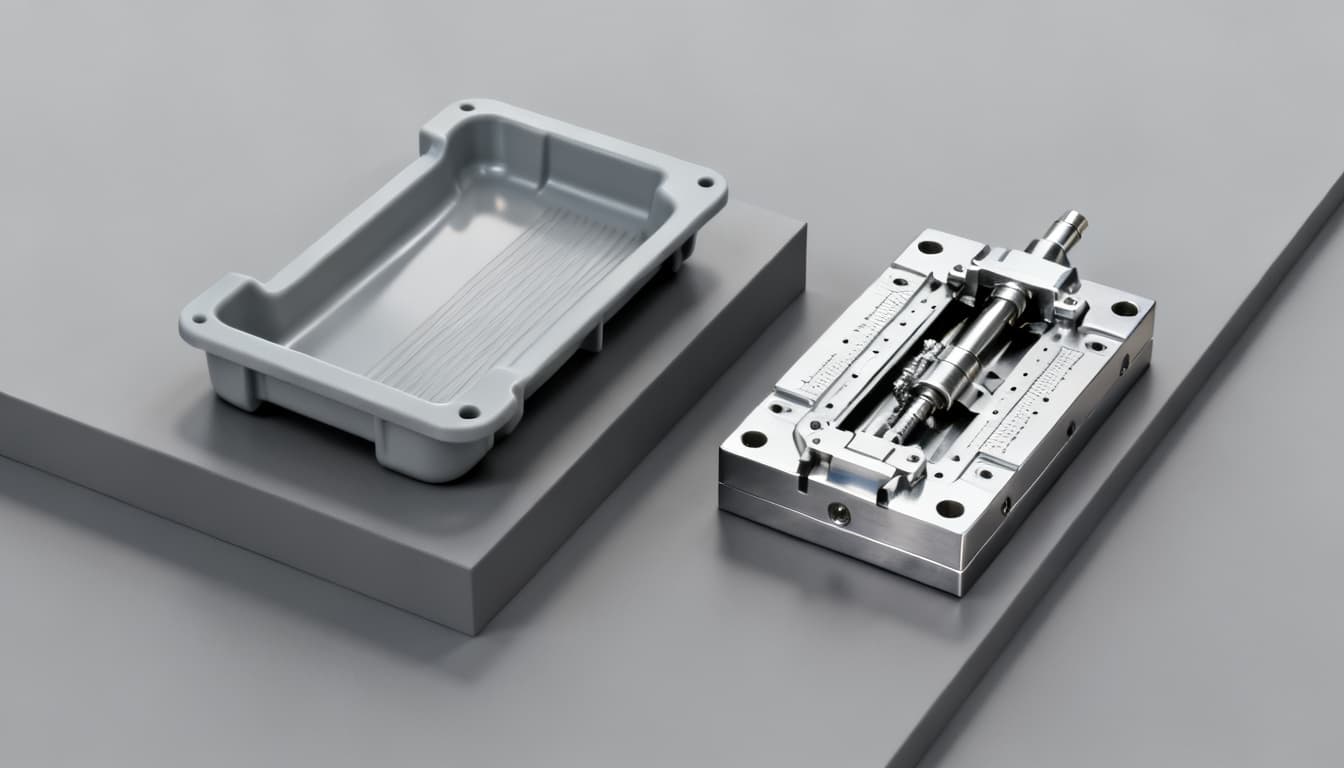
Engineer’s Selection Guide: Comparing High-Performance Thermoplastics for Aerospace Plastic Injection Applications
When a bracket fails at 35,000 feet, the cost isn't measured in dollars—it's measured in trust. Aerospace injection molding operates in a realm where material selection isn't a procurement checkbox; it's a life-safety decision chain that starts long before tool steel is cut. Yet too many engineering
When a bracket fails at 35,000 feet, the cost isn't measured in dollars—it's measured in trust. Aerospace injection molding operates in a realm where material selection isn't a procurement checkbox; it's a life-safety decision chain that starts long before tool steel is cut. Yet too many engineering teams still approach high-performance thermoplastics with the same selection framework they'd use for consumer electronics housings. That approach doesn't just risk part rejection. It risks program delays, airworthiness certification setbacks, and—in the worst case—in-flight failure.
This guide is written for the engineer who needs to move beyond datasheet comparisons and into the practical realities of qualifying PEEK, PEI, PPS, and their high-performance counterparts for aerospace injection molding. You'll find no generic polymer science lectures here. Instead, we'll walk through the material families that actually fly, the process trade-offs that shape production economics, the regulatory paperwork that keeps parts airworthy, and the questions your molder should be able to answer before you commit to a tool build.
Why Off-the-Shelf Resins Can't Fly: The Unique Demands of Aerospace Injection Molding
The injection molding materials market offers dozens of different thermoplastics, but in industrial practice, only 10 to 12 main plastic families see regular use—divided into three categories: standard, engineering, and high-performance (Tedesolutions, 2025). Aerospace applications almost exclusively occupy that top tier, and for good reason. Standard resins like ABS or polypropylene lack the thermal stability, chemical resistance, and flame performance needed to survive cabin and structural environments. Engineering grades like polycarbonate or nylon 6/6 can handle more, but still fall short when the specification calls for low smoke density, high strength-to-weight ratios, and sustained performance above 150°C.
The Protolabs thermoplastic selection guide puts this in stark terms: "If life safety is involved, or reliability or efficacy are absolutely required, every part should be engineered and materials selected accordingly" (Protolabs). That single sentence captures why aerospace injection molding demands a fundamentally different material qualification process. You're not optimizing for cycle time or color match. You're optimizing for flame propagation rates measured in millimeters per minute, smoke density thresholds that determine evacuation visibility, and toxicity limits that protect passengers and crew.
Consider a real-world example: an aerospace bracket originally machined from aluminum. By converting to PEEK via injection molding, engineers achieved significant weight reduction while maintaining structural integrity—a conversion documented in recent high-temperature plastics research (Yifuhuiplastic, 2026). Industrial-grade PEEK runs roughly $80 to $150 per kilogram, but the system-level savings from weight reduction, corrosion elimination, and part consolidation often justify the material premium many times over. The 2026 trend toward engineered plastic components in demanding sectors underscores that this isn't a niche experiment—it's becoming standard practice (Bost, 2026).
Key Takeaway: If your current material selection process starts with a cost-per-kilogram comparison, you're already approaching the problem from the wrong angle. Aerospace injection molding demands that you begin with the part's mechanical loads, operating temperature range, chemical exposure, and regulatory requirements—then work backward to the resin family that satisfies all constraints simultaneously.
From PEEK to PEI: Decoding the High-Performance Thermoplastic Families for Aerospace
The three-tier injection molding material pyramid is a useful mental model: standard resins at the base, engineering thermoplastics in the middle, and high-performance polymers at the apex. Aerospace applications draw almost exclusively from that apex, where continuous use temperatures exceed 150°C, flame-smoke-toxicity (FST) performance is non-negotiable, and mechanical properties must hold up under cyclic loading across wide temperature swings.
Proper plastic material selection considers a range of factors: mechanical loads, operating temperature range, chemical exposure, aesthetic requirements, industry standards, and economic aspects (Tedesolutions, 2025). For aerospace, that list expands to include FST compliance, outgassing characteristics, and long-term creep behavior under cabin pressure cycles. The Protolabs guide recommends that engineers "quantitatively analyze a part, determine loads, stresses, strains, and environments and make an optimal material decision based on the analysis" (Protolabs). Here's how the major aerospace-grade thermoplastic families stack up against those criteria.
| Material | Tensile Strength (MPa) | HDT @ 1.82 MPa (°C) | Continuous Use Temp (°C) | Chemical Resistance | Approx. Industrial Cost ($/kg) | Key Aerospace Application |
|---|---|---|---|---|---|---|
| PEEK (Polyetheretherketone) | 90–100 | 160–170 | 240–260 | Excellent — resists hydraulic fluids, Skydrol, fuels | $80–150 | Structural brackets, engine-adjacent components, electrical connectors |
| PEI (Polyetherimide / Ultem®) | 85–105 | 190–200 | 170–180 | Good — resistant to many solvents, limited ketone resistance | $30–60 | Cabin interiors, seat frames, galley components, air ducts |
| PPS (Polyphenylene Sulfide) | 70–90 | 260–270 | 200–220 | Outstanding — nearly universal chemical resistance | $25–50 | Fuel system components, valve bodies, pump housings |
| PAEK (Polyaryletherketone family) | 85–115 | 150–165 | 230–250 | Excellent — similar to PEEK with variant-specific strengths | $70–130 | High-load structural parts, wear-resistant bearings |
| PI (Polyimide) | 70–85 | 340–360 | 300+ | Good — limited by moisture absorption | $150–300+ | Extreme-temperature insulators, engine seals |
The cost range of $80 to $150 per kilogram for industrial-grade PEEK (Yifuhuiplastic, 2026) reflects the reality that aerospace-grade resins command a premium. But raw material price tells only part of the story. PEEK's higher continuous use temperature and superior chemical resistance may eliminate the need for secondary coatings or more frequent replacement cycles. PEI (Ultem®), while less expensive per kilogram, offers a compelling balance of FST compliance, processability, and mechanical performance that makes it the default choice for cabin interior applications where extreme chemical exposure isn't a concern.
Tip: When evaluating PEEK versus PEI for a specific part, don't stop at the datasheet. Ask your molder about cycle time differences—PEEK typically requires mold temperatures of 160–200°C and longer cooling cycles, which directly impacts part cost beyond the raw material delta.
Injection Molding vs. Thermoforming and PEEK vs. PEI: Weighing the Real Trade-offs in Aerospace Production
Not every aerospace plastic part needs to be injection molded. For cabin interior components—seat backs, tray tables, sidewall panels, window reveals—thermoforming offers a legitimate alternative with compelling economics. According to the AIP Precision aerospace plastics selection guide, thermoforming tooling costs run just 25–50% of the investment required for injection molding, with lead times as short as 4 to 6 weeks (AIP Precision). These advantages make thermoformed Ultem® particularly attractive for aircraft cabin interiors, where production volumes may not justify the upfront tooling expense of injection molding.
However, the trade-offs are real. Injection molding delivers tighter tolerances, more complex geometries, better surface finish consistency, and superior mechanical properties due to the higher pressures and more controlled cooling. For structural brackets, connector housings, and parts with threaded inserts or living hinges, injection molding remains the process of choice. The decision tree typically looks like this: if the part is non-structural, has relatively simple geometry, and production volumes are under 5,000 units annually, thermoforming deserves a hard look. If the part carries load, requires tight tolerances, or needs complex features like snap-fits and bosses, injection molding is the path forward.
| Comparison Metric | Injection Molding (PEEK/PEI/PPS) | Thermoforming (Ultem® / PEI sheet) | Selection Criteria & Failure Boundary |
|---|---|---|---|
| Tooling Cost | $30,000–$80,000+ (multi-cavity aerospace tool) | $7,500–$20,000 (25–50% of injection mold) | Choose thermoforming for volumes under 5K/yr; injection molding wins above 10K/yr |
| Lead Time (Tool Build) | 12–16 weeks typical; 20+ weeks for complex tools | 4–6 weeks | Thermoforming for accelerated development; injection molding for production scale |
| Dimensional Tolerance | ±0.05–0.15 mm achievable | ±0.25–0.50 mm typical | Injection molding required for precision fits and assembly interfaces |
| Part Complexity | High — bosses, ribs, snap-fits, threads, undercuts | Low to moderate — primarily shell geometries | Injection molding when part consolidation is a design goal |
| Material Options | Full range: PEEK, PEI, PPS, PAEK, PI, filled grades | Limited to extrudable sheet grades (primarily PEI/Ultem®) | Injection molding for PEEK structural parts; thermoforming for PEI cabin panels |
When comparing PEEK, PEI, and PPS head-to-head, the Ensinger OEM material comparison guide emphasizes that different tiers of polymers—general industrial, engineering, and high-performance—demand different processing capabilities (Ensinger Precision Components). PEEK stands as "one of the highest performing thermoplastics globally, offering exceptional strength-to-weight ratios that make it ideal for aerospace applications" (AIP Precision). PPS offers near-universal chemical resistance at a lower price point but with reduced impact toughness. PEI splits the difference—easier to process than PEEK, better mechanical properties than PPS, and inherently flame-retardant without halogenated additives.
Choosing the right injection molding manufacturer is a high-stakes decision when working with these materials. "Materials such as PEEK, PPS, and PEI offer exceptional strength, chemical resistance, and thermal stability, but they also demand precise processing, robust tooling, and disciplined quality control. While many suppliers can mold commodity plastics, far fewer have the expertise to handle these advanced materials" (Ensinger Plastics). PEEK, in particular, performs well in environments with high pressures, temperatures, or corrosive chemicals, and engineers in the aerospace and medical device sectors have found this thermoplastic to be especially effective under stress (Plastic Machining Inc.).
Note: If your molder can't show you documented process windows for PEEK or PEI—including mold temperature control within ±5°C, documented drying procedures, and evidence of screw/barrel metallurgy suitable for high-temperature processing—keep looking. The gap between molding commodity resins and aerospace-grade thermoplastics is measured in equipment capability, not just material knowledge.
Navigating FST, FAR 25.853, and the Paperwork That Keeps Parts Flying
Regulatory compliance in aerospace injection molding isn't a final gate—it's the framework that shapes every material decision from day one. FAR 25.853 governs flammability requirements for aircraft cabin interiors, specifying vertical burn, horizontal burn, and 60-second vertical burn tests depending on the part's location and function. But flame resistance is only one leg of the stool. Smoke density (measured per ASTM E662) and toxicity (measured per BSS 7239 or equivalent) complete the FST triad that determines whether a thermoplastic can fly.
The Lanxess engineering plastics design guide underscores that material certification requires documented evidence across the entire supply chain—from resin batch traceability through processing parameters to finished part testing (Lanxess Material Selection Guide). For FAA or EASA part approval, you'll typically need to demonstrate:
| Requirement | Standard / Reference | What It Means for Injection Molding | Documentation Deliverable |
|---|---|---|---|
| Flammability | FAR 25.853(a) / 14 CFR 25.853 | Material must self-extinguish within specified time; burn length limits apply | Certified test reports from ISO 17025 lab; batch-level verification |
| Smoke Density | ASTM E662 / FAR 25.853(d) | Specific optical density (Ds) must remain below thresholds during 4-minute test | Smoke chamber test data; material formulation change control documentation |
| Toxicity | BSS 7239 / ABD 0031 | Limits on HCN, CO, HCl, HF, SO₂, NOₓ emissions during combustion | Gas analysis reports; resin supplier certification of additive package |
| Material Traceability | AS9100 / FAA AC 21-43 | Full batch traceability from resin lot to finished part serial number | Material certs, incoming inspection records, lot control logs |
| Process Validation | AS9100 Section 8.5.1 / customer PO requirements | Documented process window; first article inspection (FAI) per AS9102 | FAI report, process capability study (Cpk), control plan |
The Protolabs guide reinforces that when life safety is involved, every part should be engineered and materials selected accordingly (Protolabs). In practice, this means your material selection process must consider not just whether a resin meets FAR 25.853 in its virgin state, but whether it continues to meet those requirements after aging, cleaning chemical exposure, and the cumulative wear of thousands of pressurization cycles.
Tip: Engage your molder's quality team early in the design phase. A molder with aerospace experience will have established relationships with certified testing laboratories, documented material handling procedures that preserve lot traceability, and the statistical process control infrastructure to demonstrate capability before the first production run. If your molder can't produce a sample FAI report or discuss their approach to material lot control without hesitation, you're talking to the wrong supplier.
Aerospace Injection Molding FAQ: Questions Engineers and Buyers Ask Before Cutting Steel
Q: What's the first step in validating a high-performance thermoplastic for an aerospace part?
Start with a quantitative analysis of loads, stresses, strains, and environmental exposure as recommended by the Protolabs thermoplastic selection guide (Protolabs). Then cross-reference material datasheets against the part's operating temperature range, chemical exposure, and FST requirements. Early engagement with a molder experienced in PEEK and PEI is critical—they can flag processing constraints, tooling requirements, and potential failure modes that datasheets won't reveal. Don't wait until the design is frozen to discover that your chosen material requires mold temperatures your supplier can't maintain, or that the wall thickness you've specified will create sink marks in a filled PEEK grade.
Q: How do I compare total cost of ownership between PEEK and PEI for a structural bracket?
Look beyond raw material price per kilogram. Factor in cycle time differences (PEEK runs slower due to higher mold temperatures and crystallization requirements), scrap rates (PEEK is less forgiving of process variation), post-machining needs, and tool wear (PEEK's higher processing temperatures accelerate tool steel degradation). PEEK may cost more upfront—$80 to $150 per kilogram for industrial grades (Yifuhuiplastic, 2026)—but offer longer service life or thinner wall sections that reduce weight and material consumption. Use the Ensinger comparison guide (Ensinger Precision Components) and Plastic Machining Inc.'s high-performance plastics comparison (Plastic Machining Inc.) to weigh mechanical properties against processing costs. Run the numbers over the part's expected service life, not just the first production run.
Q: What lead times should I expect for aerospace injection molds, and how can I shorten them?
Typical mold build for high-performance thermoplastics runs 12 to 16 weeks, but complex multi-cavity tools with side actions, conformal cooling, or high-polish cavity surfaces can extend to 20 weeks or more. Shorten lead times by using rapid tooling inserts for prototype and low-rate initial production runs, standardizing mold bases across part families, and collaborating early with a molder that has in-house high-temperature processing capability. The AIP Precision guide shows that thermoforming can be a faster alternative for cabin interior parts, with lead times as short as 4 to 6 weeks (AIP Precision). For injection molding, the single biggest lever you can pull is early molder engagement—before the design is finalized—so tooling can be ordered while design details are still being refined.
Q: When does it make sense to replace aluminum with a thermoplastic in a non-structural cabin component?
The business case for metal-to-plastic conversion crystallizes when weight reduction, corrosion resistance, and part consolidation through injection molding outweigh the lower stiffness of thermoplastics. PEI (Ultem®) often replaces aluminum in seat frames, galley components, and air handling components because it meets FST requirements and cuts weight by 30 to 50% compared to the metal equivalent. Validate the conversion with mechanical testing that accounts for long-term creep behavior under cabin pressure cycles—thermoplastics exhibit time-dependent deformation that aluminum doesn't. Also consider the secondary benefits: injection molding can consolidate multiple metal stampings and fasteners into a single molded part, reducing assembly labor and eliminating corrosion-prone joints. The engineered plastic components trend for 2026 confirms this conversion pattern is accelerating across aerospace programs (Bost, 2026).
Q: What documentation is typically required for FAA or EASA part approval?
Expect to provide material certifications including flammability test reports with traceability to the specific resin batch used, first article inspection (FAI) reports per AS9102, process capability data demonstrating stable production, and a detailed control plan covering incoming material inspection through final part release. The Lanxess design guide stresses the importance of material lot traceability and documented process validation to satisfy airworthiness authorities (Lanxess). In practice, this means your injection molder must maintain a quality management system certified to AS9100, operate under a documented material control procedure that prevents mix-ups, and retain process data for each production lot. If your molder can't show you a sample FAI package or explain their approach to statistical process control for high-temperature resins, the documentation burden will fall on your team—and that's a risk no aerospace program should carry.
Selecting the right high-performance thermoplastic for aerospace injection molding isn't a single decision—it's a series of interconnected choices about material, process, molder capability, and regulatory compliance. The engineers and buyers who get it right are the ones who treat material selection as a system-level optimization, not a procurement transaction. They engage molders early, validate assumptions with data, and build documentation into the development timeline from day one.
At PandaMolding, we specialize in high-performance thermoplastic injection molding for demanding aerospace applications. Our engineering team works alongside yours to navigate material selection, process development, and regulatory documentation—so your parts fly right the first time. Contact us today to discuss your aerospace injection molding project.
References & Further Reading
- Thermoplastic Material Selection for Injection Molding — Protolabs — Comprehensive guide aimed at engineers performing quantitative part analysis for life-safety applications.
- Selecting Engineering Plastics for Injection Molding — Practical Guide 2025 — Tedesolutions — Covers the three-tier material categorization and key selection factors including mechanical loads, temperature range, and chemical exposure.
- High Temperature Engineering Plastics: 2026 Selection Guide — Yifuhuiplastic — Includes aerospace bracket weight-saving examples and industrial PEEK cost data ($80–$150/kg).
- Engineered Plastic Components Guide 2026 — Bost — Industry trends and material comparisons for high-performance plastic components.
- Aerospace Plastics Selection Guide — AIP Precision — Thermoforming vs. injection molding cost and lead time comparisons; PEEK strength-to-weight analysis for aerospace structures.
Want to discuss your project?
Use the quick bar below or this form—we will route you to an engineer.
Contact us