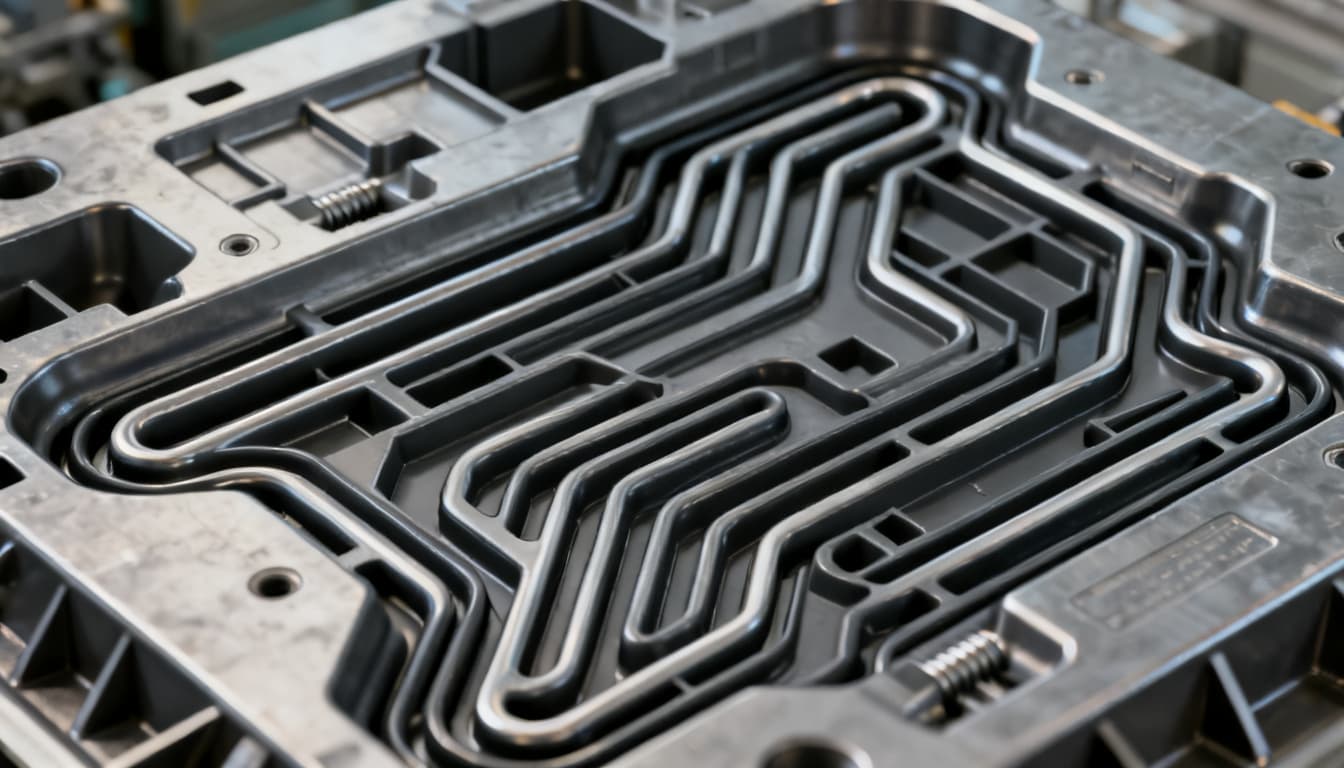
Innovative Cooling Channel Design Techniques for Complex Injection Molded Parts
As injection molding engineers, we often face the challenge of optimizing cooling times without compromising the quality of complex parts. An improperly designed cooling system can lead to defects like warping, sink marks, and residual stresses. This article delves into advanced cooling channel desi
Innovative Cooling Channel Design Techniques for Complex Injection Molded Parts
As injection molding engineers, we often face the challenge of optimizing cooling times without compromising the quality of complex parts. An improperly designed cooling system can lead to defects like warping, sink marks, and residual stresses. This article delves into advanced cooling channel designs that address these issues, offering insights backed by industry standards and real-world experience.
Understanding the Importance of Cooling in Injection Molding
The cooling phase is critical in the injection molding cycle, accounting for up to 80% of the total cycle time. Efficient cooling improves productivity and part quality. For complex parts, traditional cooling methods may not suffice, necessitating innovative approaches.
Cycle Time Reduction
In typical scenarios, cycle time can be reduced by 20-30% with optimized cooling channels. For instance, a part originally having a 60-second cycle time can be reduced to 42-48 seconds. This reduction is achieved by enhancing heat transfer efficiency using conformal cooling channels.
Quality Improvement
Properly designed cooling systems minimize defects. For example, by maintaining uniform mold temperatures (typically between 20°C and 80°C depending on the material), issues like warping and sink marks are reduced. This uniformity is crucial for materials such as ABS and PC, which are sensitive to temperature variations.
Conformal Cooling Channels
Conformal cooling channels are designed to follow the geometry of the molded part, providing uniform cooling. This technique is particularly beneficial for complex geometries where traditional straight-line channels are ineffective.
Design Considerations
When designing conformal cooling channels, it's crucial to maintain a consistent distance from the part surface, typically between 10mm and 15mm, to ensure even cooling. The channel diameter should be optimized based on the material and part thickness.
Material Compatibility
Conformal cooling is particularly effective with high-thermal-conductivity materials like aluminum molds. However, it can also be applied to steel molds with careful design considerations.
| Material | Thermal Conductivity (W/mK) | Recommended Cooling Method |
|---|---|---|
| Aluminum | 150-235 | Conformal Cooling |
| Steel | 15-50 | Conformal or Baffle Cooling |
Advanced Baffle and Bubbler Systems
For parts where conformal cooling is not feasible, advanced baffle and bubbler systems offer an alternative. These systems can enhance cooling efficiency in complex molds.
Baffle Systems
Baffles are inserted into the cooling channels to direct the coolant flow, increasing turbulence and heat transfer. They are effective in areas with limited space for conventional channels.
Bubbler Systems
Bubblers introduce air bubbles into the coolant flow, disrupting the boundary layer and improving heat transfer. This technique is useful for molds with deep cores or intricate features.
| System Type | Application | Cooling Efficiency |
|---|---|---|
| Baffle | Confined Spaces | Moderate |
| Bubbler | Deep Cores | High |
Utilizing Computational Fluid Dynamics (CFD)
CFD simulations are invaluable for optimizing cooling channel designs. By simulating coolant flow and heat transfer, engineers can predict and mitigate potential issues before physical mold production.
Steps for CFD Analysis
- Define the geometry of the part and cooling channels.
- Set material properties and boundary conditions.
- Run simulations to analyze coolant flow and temperature distribution.
- Adjust the design based on simulation results for optimal performance.
Addressing Common Cooling Channel Design Mistakes
Even experienced engineers can fall into common pitfalls when designing cooling channels. Recognizing and addressing these mistakes is crucial for successful mold production.
Inadequate Channel Diameter
Channels that are too narrow can restrict coolant flow, leading to inefficient cooling. Ensuring a diameter that balances flow rate and pressure drop is essential.
Uneven Cooling
Uneven cooling can cause warping and dimensional inaccuracies. Using CFD analysis and maintaining consistent channel distances can mitigate these issues.
Practical Tip: Always validate cooling channel designs with prototype testing. This helps identify real-world discrepancies that simulations might miss.
Conclusion
Innovative cooling channel designs are essential for producing high-quality, complex injection molded parts efficiently. By leveraging technologies like conformal cooling and CFD, and understanding the nuances of advanced cooling systems, engineers can significantly enhance mold performance. For detailed guidance and to get a free quote on your next project, reach out to our team at Panda Molding.