Innovative Mold Design Strategies to Enhance Precision and Minimize Waste in Injection Molding
Precision and waste management are critical concerns in injection molding. As demands for tighter tolerances and sustainable practices increase, mold design becomes a pivotal factor in achieving these goals. In this article, we explore advanced strategies that can significantly enhance precision and
Innovative Mold Design Strategies to Enhance Precision and Minimize Waste in Injection Molding
Precision and waste management are critical concerns in injection molding. As demands for tighter tolerances and sustainable practices increase, mold design becomes a pivotal factor in achieving these goals. In this article, we explore advanced strategies that can significantly enhance precision and reduce waste in the injection molding process.
Understanding Material Behavior and Selection
Material selection is fundamental in influencing the precision and efficiency of the injection molding process. Each material has unique properties that affect its behavior during molding, including melt temperature, shrinkage rate, and flow characteristics.
Comparing Material Properties
| Material | Melt Temperature (°C) | Shrinkage Rate (%) | Application |
|---|---|---|---|
| ABS | 220-260 | 0.4-0.8 | Automotive, Electronics |
| PP | 200-250 | 1.0-2.5 | Packaging, Textiles |
| PC | 270-310 | 0.5-0.7 | Optical Discs, Safety Equipment |
| PA66 | 260-290 | 1.2-2.0 | Gears, Bearings |
Practical Material Selection Tips
Choosing the right material involves balancing mechanical properties with processing conditions. For instance, while ABS offers excellent impact resistance, its higher melt temperature requires specific considerations for mold cooling to avoid warping.
Designing for Manufacturability
Design for manufacturability (DFM) is crucial in reducing waste and improving precision. This involves optimizing part geometry to facilitate the molding process, minimizing defects, and ensuring consistent quality.
Key Design Rules
- Wall Thickness: Maintain uniform wall thickness between 1-3mm to prevent sink marks and warping.
- Draft Angles: Apply draft angles of 0.5-2° to facilitate easy ejection from the mold.
- Rib Design: Ribs should be 50-60% of the wall thickness to avoid flow issues and ensure structural integrity.
Case Study: Reducing Cycle Time
In a recent project involving a consumer electronics component, optimizing the rib design and wall thickness reduced the cycle time from 30 seconds to 24 seconds, resulting in a 20% increase in production efficiency.
Advanced Mold Technology
Incorporating advanced technologies in mold design can further enhance precision and reduce waste. Technologies such as conformal cooling and hot runner systems play a significant role in modern injection molding.
Conformal Cooling
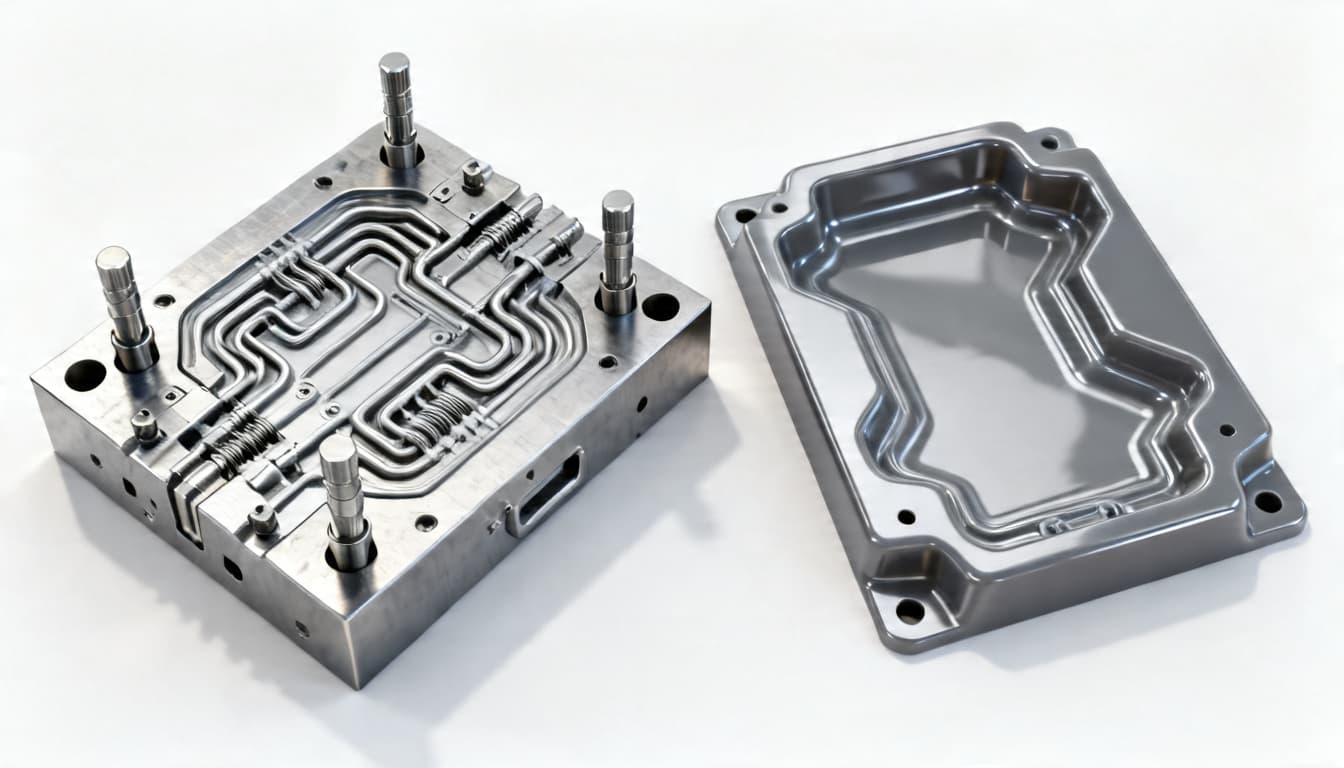
Conformal cooling channels, designed to match the contours of the mold cavity, improve heat transfer efficiency. This results in uniform cooling, reducing cycle times and improving part consistency.
Hot Runner Systems
Hot runner systems eliminate the need for runners, reducing material waste and improving cycle time. These systems maintain the plastic at an optimal temperature, ensuring better flow and reduced defects.
Checklist for Implementing Advanced Mold Technologies
- Evaluate the part design for compatibility with conformal cooling.
- Select a hot runner system suitable for the material and part complexity.
- Conduct thermal simulations to optimize the cooling channel layout.
- Implement process monitoring to ensure consistent performance.
Process Optimization for Precision
Process optimization is essential for achieving precision in injection molding. This involves fine-tuning parameters such as injection pressure, mold temperature, and cycle time.
Optimizing Injection Parameters
| Parameter | ABS | PP | PC | PA66 |
|---|---|---|---|---|
| Injection Pressure (bar) | 500-1000 | 600-1200 | 800-1400 | 700-1300 |
| Mold Temperature (°C) | 60-80 | 30-60 | 80-110 | 80-120 |
| Cycle Time (seconds) | 30-60 | 25-50 | 40-70 | 45-75 |
Common Mistakes and Solutions
One common mistake is neglecting the impact of mold temperature on part quality. For example, inadequate mold temperature can lead to poor surface finish and increased shrinkage. Ensuring optimal mold temperature can mitigate these issues, resulting in higher quality parts.
Practical Tip: Regularly calibrate your injection molding machine and conduct mold flow analysis to identify potential issues before production.
Conclusion
Innovative mold design strategies are essential for enhancing precision and minimizing waste in injection molding. By understanding material behavior, designing for manufacturability, implementing advanced technologies, and optimizing process parameters, manufacturers can achieve significant improvements in efficiency and product quality. For tailored solutions and expert guidance, consider reaching out to get a free quote from Panda Molding.