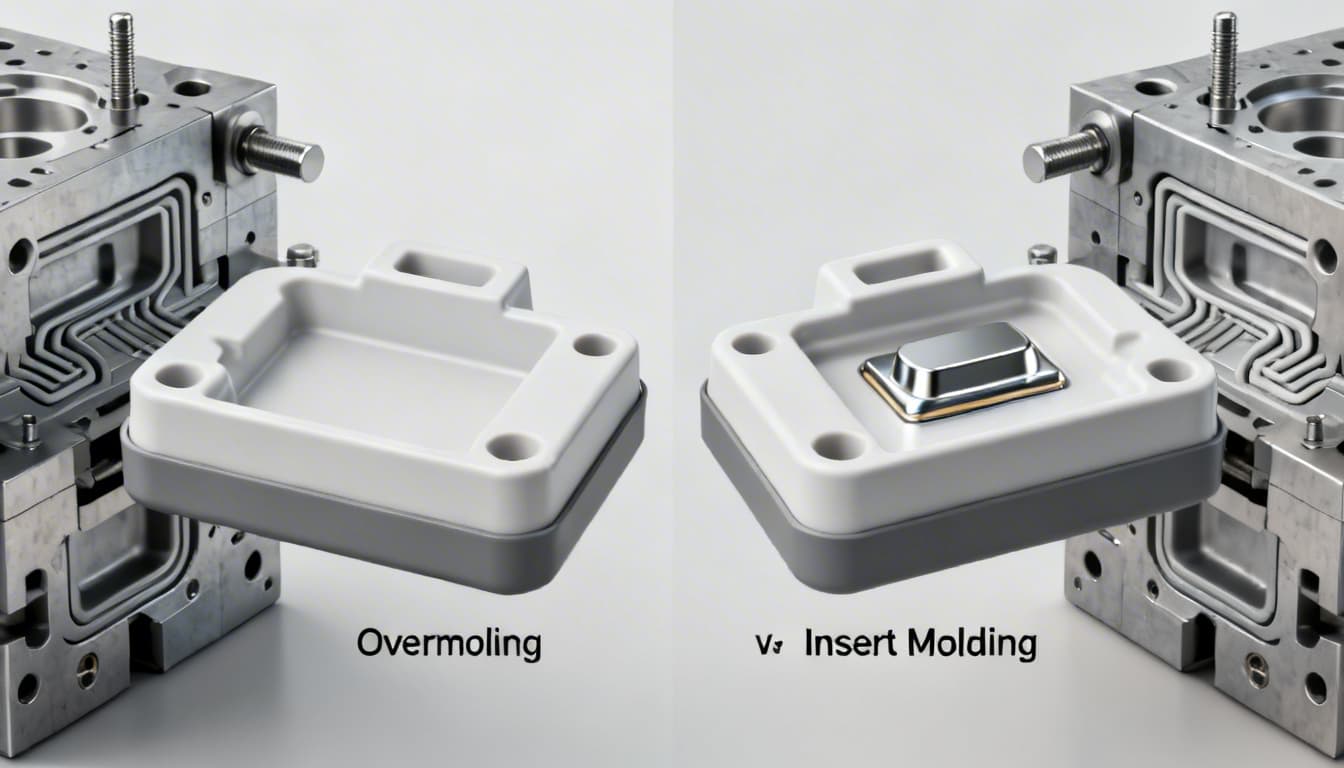
Overmolding vs Insert Molding: An Engineer’s Guide to Choosing the Right Process with Real-World Data
Choosing between overmolding and insert molding is a critical decision for engineers and product designers. Each process offers unique advantages and limitations, often making the choice challenging. This guide will help you navigate these complexities by providing real-world data and insights from
Overmolding vs Insert Molding: An Engineer’s Guide to Choosing the Right Process with Real-World Data
Choosing between overmolding and insert molding is a critical decision for engineers and product designers. Each process offers unique advantages and limitations, often making the choice challenging. This guide will help you navigate these complexities by providing real-world data and insights from my 15+ years of experience in injection molding.
Understanding Overmolding and Insert Molding
What is Overmolding?
Overmolding is a process where a single part is created using two or more materials. It involves molding a secondary material over a base substrate, which can be plastic, metal, or another material. The process is commonly used in applications where a soft grip, aesthetic appeal, or functional enhancement is required.
What is Insert Molding?
Insert molding involves placing a pre-formed insert, typically metal, into the mold cavity. The plastic is then injected around the insert, encapsulating it. This process is ideal for creating parts with integrated metal components, such as threaded inserts or electrical contacts.
Comparing Process Parameters
Both overmolding and insert molding have specific process parameters that need to be carefully controlled to ensure quality and performance.
| Parameter | Overmolding | Insert Molding |
|---|---|---|
| Melt Temperature (°C) | 200-260 | 180-240 |
| Mold Temperature (°C) | 40-80 | 30-70 |
| Injection Pressure (bar) | 500-1500 | 400-1200 |
| Cycle Time (seconds) | 30-90 | 20-60 |
Material Compatibility and Selection
Choosing the Right Materials
Material selection is crucial for both overmolding and insert molding. The compatibility between the substrate and overmold material or the insert and surrounding plastic must be considered to prevent defects.
| Material | Common Uses | Overmolding Compatibility | Insert Molding Compatibility |
|---|---|---|---|
| ABS | Consumer electronics | Good with TPE | Good with metal inserts |
| PP | Automotive parts | Fair with TPE | Good with metal inserts |
| PC | Optical lenses | Good with TPE | Good with metal inserts |
| PA66 | Mechanical components | Poor with TPE | Excellent with metal inserts |
| POM | Precision parts | Poor with TPE | Excellent with metal inserts |
Design Considerations
Design Rules for Overmolding
When designing for overmolding, considerations include maintaining proper wall thickness, ensuring adequate draft angles, and avoiding sharp corners. Typical design rules include:
- Wall thickness: 1-3mm
- Draft angles: 0.5-2°
- Radius on corners: Minimum 0.5mm
Design Rules for Insert Molding
Insert molding requires precise placement of inserts and considerations for thermal expansion and bonding. Key design rules include:
- Insert placement tolerance: ±0.1mm
- Preheat inserts to reduce thermal shock
- Ensure mechanical bonding features for better adhesion
Common Defects and Solutions
Overmolding Defects
Common defects in overmolding include delamination, warping, and poor adhesion. Solutions include optimizing mold temperature and ensuring material compatibility.
Insert Molding Defects
Defects such as incomplete filling and insert movement can occur. These can be mitigated by adjusting injection pressure and ensuring proper insert placement.
Cost and Efficiency Considerations
Cost Breakdown
Both processes have different cost implications. Overmolding can be more expensive due to the need for multiple materials, while insert molding may require additional handling and pre-processing of inserts.
- Material Costs: Overmolding typically requires more material types.
- Cycle Time: Insert molding often has shorter cycle times due to fewer material interactions.
- Tooling Costs: Overmolding may require more complex tooling designs.
Practical Tip: Always conduct a thorough cost-benefit analysis for each project. Consider not just the immediate costs, but also the long-term benefits and potential for reduced defects and improved product performance.
Conclusion
Choosing between overmolding and insert molding involves careful consideration of materials, design, and cost. Overmolding is ideal for multi-material parts that require enhanced functionality or aesthetics, while insert molding is better suited for integrating metal components. By understanding the specific parameters and potential pitfalls of each process, you can make informed decisions that optimize both performance and cost.
For expert guidance and to explore our comprehensive injection molding services, get a free quote today.