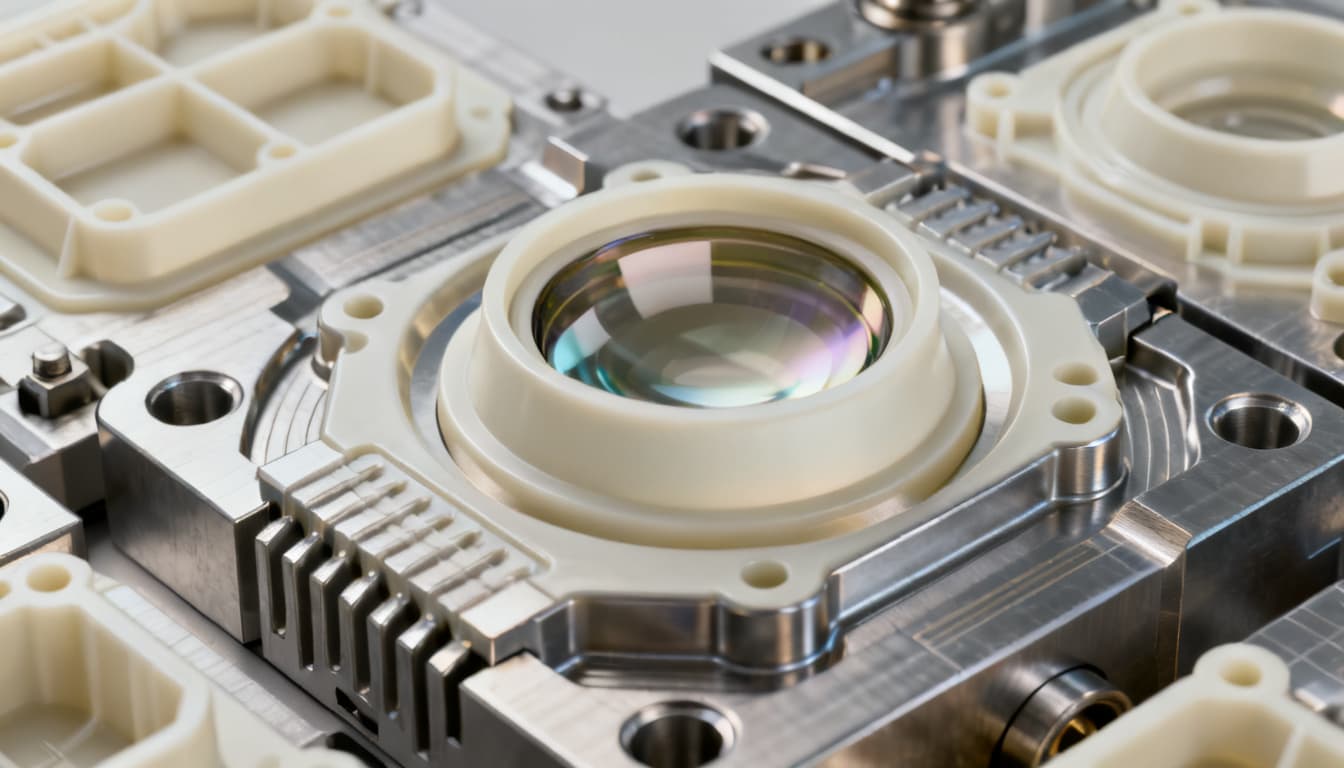
Precision Matters: Key Considerations for Optical Lens Injection Molding Success
Producing optical lenses through injection molding is a nuanced process that demands accuracy and expertise. A single misstep can lead to defects that compromise optical performance, making understanding the intricacies of this process critical for success.
Precision Matters: Key Considerations for Optical Lens Injection Molding Success
Producing optical lenses through injection molding is a nuanced process that demands accuracy and expertise. A single misstep can lead to defects that compromise optical performance, making understanding the intricacies of this process critical for success.
Understanding Material Selection for Optical Lenses
Choosing the right material is the cornerstone of successful optical lens injection molding. Optical clarity, refractive index, and mechanical properties are paramount in material selection.
Common Materials and Their Properties
Polycarbonate (PC) and Polymethyl Methacrylate (PMMA) are the most common materials used in optical lens production due to their excellent clarity and impact resistance.
| Material | Refractive Index | Light Transmission (%) | Impact Resistance |
|---|---|---|---|
| Polycarbonate (PC) | 1.586 | 88-90% | High |
| Polymethyl Methacrylate (PMMA) | 1.49 | 92% | Moderate |
Critical Process Parameters for Precision Molding
Precision in injection molding is heavily reliant on maintaining optimal process parameters. These include melt temperature, mold temperature, injection pressure, and cycle time.
Key Parameters and Their Impact
| Parameter | Recommended Range | Impact on Quality |
|---|---|---|
| Melt Temperature | 240-280°C (PC), 200-250°C (PMMA) | Affects clarity and flow |
| Mold Temperature | 80-110°C (PC), 50-70°C (PMMA) | Influences cooling rate and dimensional accuracy |
| Injection Pressure | 800-1400 bar | Determines fill and packing efficiency |
| Cycle Time | 30-90 seconds | Impacts production efficiency and cost |
Design Considerations for Optical Lenses
Designing molds for optical lenses requires attention to detail to avoid defects and ensure high-quality output.
Essential Design Rules
- Wall Thickness: Maintain uniform thickness between 1-3mm to prevent warping and ensure even cooling.
- Draft Angles: Implement draft angles of 0.5-2° to facilitate easy demolding.
- Gate Location: Position gates to minimize weld lines and ensure uniform flow.
Common Defects and Their Solutions
Despite careful planning, defects can occur. Identifying and rectifying these issues promptly is crucial.
Typical Defects and Corrective Actions
- Flow Lines: Caused by uneven flow, resolved by adjusting melt temperature or gate location.
- Sink Marks: Result from insufficient packing pressure, corrected by increasing pressure or optimizing cooling time.
- Warping: Often due to uneven cooling, mitigated by ensuring uniform wall thickness and mold temperature.
Quality Control and Testing
Ensuring the quality of optical lenses involves rigorous testing and adherence to industry standards such as ISO 9001 and ISO 13485.
Quality Assurance Checklist
- Conduct visual inspections for surface defects.
- Verify dimensional accuracy using precision measuring tools.
- Test optical properties such as clarity and refractive index.
- Perform stress testing to assess impact resistance.
- Document all findings and implement corrective actions as needed.
Practical Tip: Always maintain a comprehensive log of process parameters and outcomes. This data is invaluable for troubleshooting and optimizing future production runs.
Conclusion
Injection molding of optical lenses is a complex process that demands precision and expertise. By carefully selecting materials, optimizing process parameters, adhering to design rules, and implementing robust quality control measures, manufacturers can produce high-quality lenses that meet stringent optical requirements. For more information or to discuss your specific needs, get a free quote from Panda Molding today.