PC/ABS Flame Retardant Housing Molding
Panda Molding delivers precision PC/ABS flame retardant housing molding for the electronics industry, combining exceptional impact strength with UL94 V-0 compliance. Our advanced injection molding processes ensure tight tolerances and consistent part quality for enclosures, connectors, and protective shells that meet strict safety standards without compromising design flexibility.
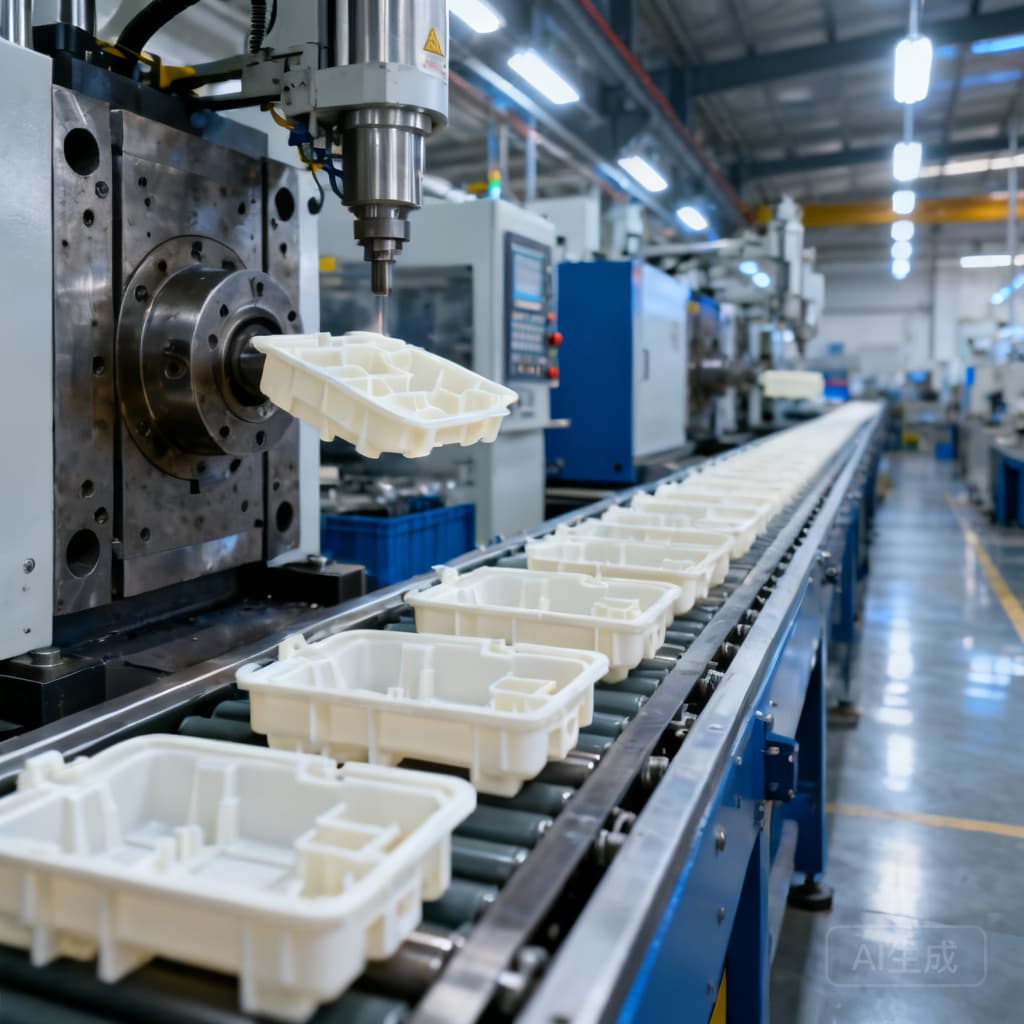
Overview
For electronics OEMs facing warpage, flash, and cycle-time overruns in flame-retardant housings, Panda Molding delivers precision PC/ABS Flame Retardant Housing Molding with ISO9001-certified consistency. Our engineered process mitigates cosmetic defects and ensures UL94 V-0 compliance, avoiding costly recalls. Get reliable, high-yield production from prototype to volume.
", "description": "PC/ABS Flame Retardant Housing Molding — Custom Injection Molding by Panda Molding
\nEvery electronics housing must balance flame retardancy, aesthetics, and mechanical integrity. Recent data from the CPSC recall database and a Sedgwick 2025 product safety report show a sharp rise in recalls tied to non-compliant flame-retardant plastics. Manufacturers face heavy fines or border stops if compounds don't meet next-gen safety standards (Plastics Technology, 2025). Even compliant materials can suffer cosmetic defects—like the poor surface aesthetics that slashed yield in a flame-retardant polyamide part (Madison Group case study). Panda Molding's PC/ABS Flame Retardant Housing Molding service eliminates these risks with a process engineered for zero-defect, UL94 V-0 production.
\n\nMaterial Selection Comparison for Flame-Retardant Housings
\n| Material | \nUL94 Rating | \nTypical Cost ($/kg) | \nKey Processing Challenge | \nFailure Boundary | \n
|---|---|---|---|---|
| FR-ABS | \nV-0 at 1.5 mm | \n2.50–3.501 | \nPlate-out after ~50k cycles; limited heat resistance | \nMelt temperature >250°C causes yellowing and FR degradation; sink marks if packing insufficient | \n
| FR-PC | \nV-0 at 1.5 mm, 5VA possible | \n3.50–5.00 | \nHigh melt viscosity requires elevated temperatures; stress cracking risk | \nMold temperature <80°C leads to high internal stress and warpage; inadequate drying causes splay | \n
| FR PC/ABS (halogen-free) | \nV-0 at 1.5 mm, some grades V-0 at 0.8 mm2 | \n3.00–4.50 | \nMoisture sensitivity; narrow processing window to avoid FR decomposition | \nResidual moisture >0.02% causes hydrolysis and surface defects; excessive shear from small gates degrades FR additives | \n
| FR PC/ABS (mineral-filled) | \nV-0 at 1.5 mm | \n3.20–5.00 | \nIncreased viscosity; tool wear; anisotropic shrinkage | \nWarpage due to differential shrinkage; poor knit-line strength at high filler loading | \n
Data compiled from CoreLMould, Alpine Mold, and industry processing guides. Cost ranges are indicative for medium-volume production.
\n\nService Capabilities
\n- \n
- Precision Tolerances: Achieve ±0.05 mm on critical dimensions for snap-fit and sealing surfaces, verified with CMM inspection. \n
- Flame-Retardant Integrity: Closed-loop melt temperature control within ±2°C to prevent FR additive degradation, ensuring consistent UL94 V-0 performance across every cavity. \n
- Optimized Tooling: Multi-cavity molds with balanced hot-runner systems and valve gates to minimize shear and eliminate knit-line weakness in thin-walled housing sections. \n
- Surface Finish Options: SPI A-2 to B-1 finishes, with in-mold texturing and anti-fingerprint coatings available for consumer-facing electronics. \n
- Full Traceability: Lot-level material certification and process data logging per ISO9001, supporting your regulatory compliance and recall prevention. \n
Industries & Applications
\nPC/ABS Flame Retardant Housing Molding is the backbone of modern electronics enclosures. In consumer electronics—smart speakers, power adapters, and home automation hubs—the alloy delivers UL94 V-0 at 1.5 mm while maintaining the impact strength needed for daily handling. Automotive interior housings (center console bezels, sensor enclosures) benefit from PC/ABS's low volatile organic compound (VOC) profile and heat resistance up to 100°C, meeting OEM flammability standards. Industrial control panels and IoT gateways rely on the material's chemical resistance and dimensional stability in unconditioned spaces. Even medical device housings (non-patient contact) use biocompatible FR grades, where consistent surface quality and absence of flash are critical for device assembly and sterilization compatibility.
\n\nOur Injection Molding Process
\n- \n
- Material Drying: PC/ABS FR pellets are dried in a dehumidifying dryer at 80–90°C for 4 hours to achieve <0.02% moisture content, as recommended by Polyrocks processing guidelines. Insufficient drying leads to splay and FR decomposition, directly causing cosmetic defects and V-0 failure. \n
- Melt Preparation: Barrel temperatures profiled from 230°C (rear) to 260°C (nozzle), with back pressure set at 3–10 kg/cm² (Polyrocks) to homogenize the melt without overheating. Screw speed limited to 50–80 rpm to avoid excessive shear that degrades the flame retardant. \n
- Injection & Packing: Moderate injection velocity prevents jetting and burn marks; packing pressure at 50–70% of injection pressure compensates for 0.5–0.7% mold shrinkage (PC/ABS alloy guide). Gate size and location are designed to avoid hesitation and ensure complete filling, especially around bosses and ribs. \n
- Cooling & Ejection: Mold temperature maintained at 70–90°C using turbulent water flow; uniform cooling channels minimize differential shrinkage. Draft angles of 1–2° on ribs and bosses ensure clean ejection without stress whitening, preserving surface aesthetics. \n
Quality Assurance
\nEvery lot of PC/ABS Flame Retardant Housing Molding undergoes dimensional inspection on a coordinate measuring machine (CMM) against the 3D CAD model, with critical-to-function features held to ±0.05 mm. Material certification includes UL yellow card verification and RoHS compliance documentation. Surface finish is audited to SPI standards using profilometry and visual inspection under controlled lighting. Functional testing encompasses UL94 vertical burn tests on molded plaques from each production run, Izod impact testing per ASTM D256, and thermal cycling where specified. Our ISO9001-certified quality system ensures full traceability from raw resin lot to finished part, supporting your regulatory submissions and recall prevention efforts.
\n\nFrequently Asked Questions
\n- \n
- Q: What materials are compatible with PC/ABS Flame Retardant Housing Molding? \n
- A: We process a wide range of FR PC/ABS grades, including halogen-free and mineral-filled variants, from suppliers like Covestro, SABIC, and Polyrocks. Custom color matching is available, and we can incorporate UV stabilizers or anti-static additives as needed. All materials are RoHS compliant and supported by UL yellow cards. \n
- Q: What is the typical lead time? \n
- A: Prototype tooling (single-cavity) can be ready in 2–3 weeks, with sample parts shipped within 1 week after mold trial. Production molds (multi-cavity) typically require 4–6 weeks, and first article inspection reports are provided 2 weeks after mold approval. Expedited services are available for urgent programs. \n
- Q: What are the MOQ requirements? \n
- A: For prototyping, we accept orders as low as 50–200 parts. Production MOQs start at 1,000 units for standard FR PC/ABS grades, with higher volumes unlocking dedicated tooling and automated production cells. We work with you to scale from pilot runs to full mass production seamlessly. \n
Request a Free Quote
\nUpload your 3D CAD file or 2D drawing for a complimentary design-for-manufacturability (DFM) review. Our engineers will assess gate placement, wall thickness, and draft to optimize your PC/ABS Flame Retardant Housing Molding for cost and quality. Expect a detailed quotation within 24–48 hours, including tooling, unit price, and lead time. Start your project today.
\n\nReferences & Further Reading
\n- \n
- CPSC Recalls & Product Safety Warnings – U.S. government recall database \n
- Madison Group: Cosmetic Defect Analysis in FR Parts \n
- Sedgwick 2025 Product Safety & Recall Index \n
- Plastics Technology: FR Compound Compliance Trends 2025 \n
- Polyrocks: Molding Processing Steps of Flame-Retardant PC/ABS \n
- CoreLMould: FR-ABS vs FR-PC vs FR-PC/ABS \n
- Alpine Mold: ABS, PC, PC/ABS Comparison \n
- CavityMold: ABS vs PC vs PMMA \n
- MatWeb: Polymer Resources PC/ABS-FR1 Data Sheet \n
- Albis: Alcom LB PC+ABS Processing Guide \n
- SalesPlastics: PC/ABS Alloy Guide \n