TPE Soft-Touch Grip Overmolding
Enhance consumer products with our TPE Soft-Touch Grip Overmolding—precision injection molding that bonds a velvety, non-slip layer onto rigid substrates for superior ergonomics and durability. Ideal for tool handles, electronics, and everyday items, it elevates comfort, style, and brand perception.
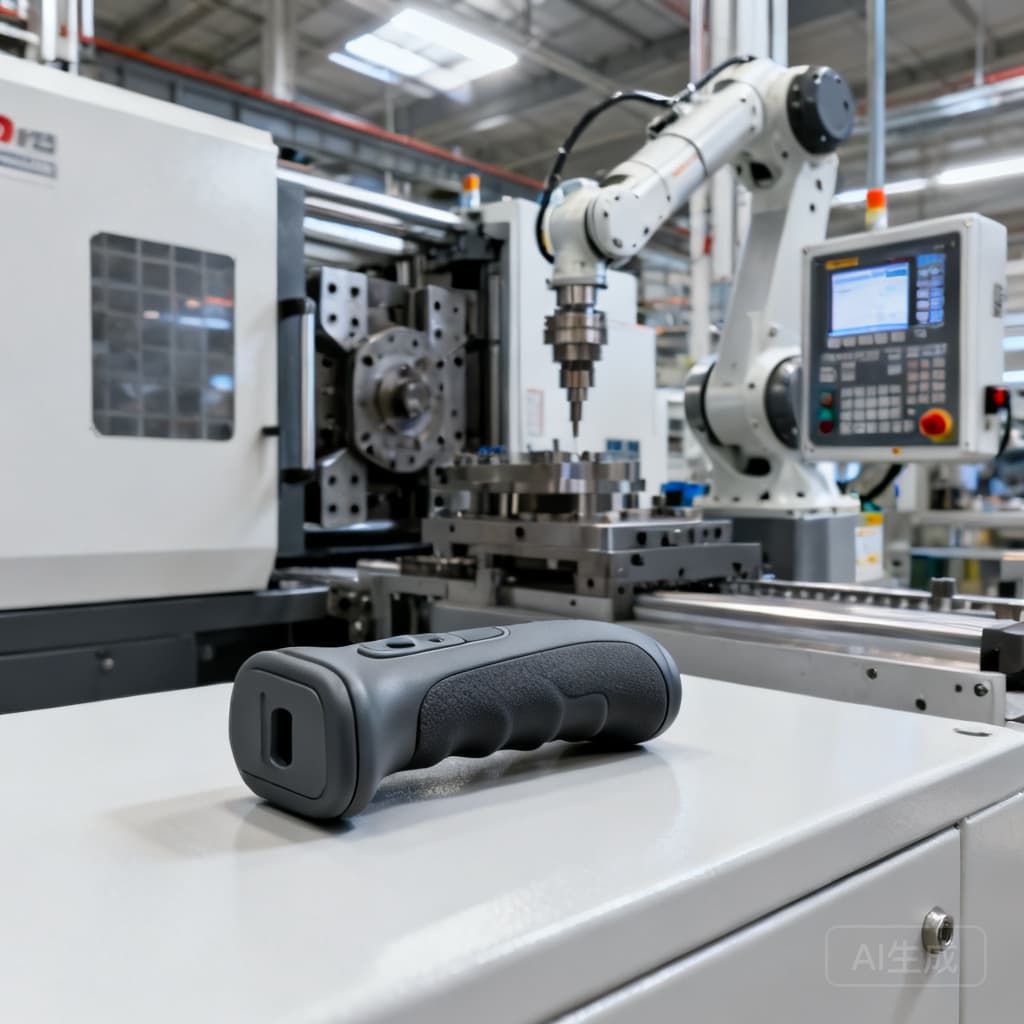
Overview
Peeling grips, mold growth in micro-gaps, and flash-prone overmolds ruin consumer confidence. Panda Molding's TPE Soft-Touch Grip Overmolding service eliminates these failures with precision bonding, ISO9001 process control, and deep material expertise. We deliver durable, ergonomic parts that feel premium and last—backed by real engineering, not guesswork.
", "description": "TPE Soft-Touch Grip Overmolding — Custom Injection Molding by Panda Molding
\nWhen a power tool handle delaminates after 500 vibration cycles or a medical device grip traps moisture and breeds mold in adhesive micro-gaps, the root cause isn't just material choice—it's process control. Field failures like peeling edges and hygiene breakdowns show what happens when overmolding lacks proper bonding, venting, and thermal management. Panda Molding's TPE Soft-Touch Grip Overmolding service addresses these pain points head-on. We combine ISO9001-certified tooling, precise melt delivery, and substrate compatibility analysis to produce soft-touch grips that bond permanently, resist delamination, and meet demanding consumer ergonomic requirements. Whether you need a single prototype cavity or high-volume production, our engineering team ensures your plastic part performs from day one.
\n\nService Capabilities
\n- \n
- Material Pairing & Bond Strength: We pre-qualify rigid substrates (ABS, PC, PP, PA) with TPE grades (SEBS, TPV, TPU) using chemical compatibility data and mechanical interlock design. For cost-sensitive tactile grips, standard SEBS-based TPE with Shore A 40–60 is typical; sealing applications may use softer 20–40 Shore A. Shore hardness directly governs feel and compliance. \n
- Multi-Cavity & Family Tooling: We design and build injection molds with up to 16+ cavities, incorporating optimized gate locations (edge, fan, or valve gates) to balance fill and minimize knit lines. Runner systems are engineered for minimal pressure drop and shear heating, critical for TPE's viscosity sensitivity. \n
- Process Control for Zero Defects: Melt temperature profiling (typically 180–220 °C for SEBS), injection speed ramping, and packing pressure curves are dialed in to prevent flash, short shots, and sink marks. Real-time monitoring of cavity pressure and cushion ensures repeatable shot size and prevents cycle-time overruns. \n
- Rapid Prototyping & Bridge Tooling: Single-cavity prototype tools with steel or aluminum inserts allow functional testing within 10–15 business days. We validate overmold adhesion via peel tests and thermal cycling before committing to production tooling. \n
- Secondary Operations: In-house pad printing, laser etching, and ultrasonic welding for assemblies are available, so your soft-touch grip arrives market-ready. \n
Industries & Applications
\nTPE Soft-Touch Grip Overmolding is essential wherever consumer perception and ergonomics intersect. In power tools and garden equipment, the overmold must withstand vibration, sweat, and UV exposure without peeling—durability tests with 500+ cycles are our baseline. For personal care items like toothbrushes and razors, we use ribbed core designs to mimic thick cushioning while reducing material weight, a technique recommended in design guides to avoid sink and excessive shrinkage. Medical device housings and wearable electronics demand biocompatible, cleanable surfaces; our validated processes prevent the micro-gap mold growth that plagues poorly bonded grips. Consumer electronics—remote controls, game controllers, earbud cases—rely on precise gate vestige control and consistent Shore A feel across millions of shots. Below is a quick comparison of common overmold material options and their failure boundaries.
\n| Material | Typical Hardness (Shore A) | Best Substrate Bond | Failure Boundary |
|---|---|---|---|
| SEBS-based TPE | 0–90 (grips 40–60) | PP, PE, ABS (with tie layer) | Delamination above 70°C continuous; poor chemical resistance to oils |
| TPV (PP/EPDM) | 35–50 | PP (excellent) | Limited bond to PC/ABS without mechanical lock; higher density than SEBS |
| TPU (polyester/polyether) | 60–95 | PC, ABS, nylon | Higher cost and density (1.2 g/cm³); may yellow under UV without stabilization |
| Liquid Silicone (LSR) | 10–70 | PC, PA (with primer) | Longer cycle times; 2-shot tooling complexity; higher part cost |
For consumer electronics requiring a soft, rubbery feel at a lower price point, SEBS-based TPE is the industry standard, as Trumax Manufacturing notes. We help you navigate these trade-offs early, avoiding field failures.
\n\nOur Injection Molding Process
\n- \n
- Substrate Molding & Conditioning: The rigid plastic part is injection molded first, with precise shrinkage compensation (0.5–1.5% for ABS, PC) to maintain critical dimensions. Parts are dried and surface-treated if needed to activate bonding sites. \n
- Overmold Tool Design: The second-shot cavity is designed with 0.5–1.5° draft angles on TPE walls, venting grooves ≤0.02 mm deep to prevent gas traps, and gate placement that directs flow along the bond line for maximum adhesion. Common defects like flash and short shots are engineered out at this stage. \n
- TPE Injection & Bonding: TPE pellets are dried to <0.05% moisture, melted at a controlled temperature profile, and injected at moderate speeds (typically 50–150 mm/s) to avoid jetting. Packing pressure is held until the gate freezes, ensuring intimate contact with the substrate while minimizing residual stress. \n
- Cooling & Ejection: Cycle times are optimized (often 20–40 seconds for a typical grip) using conformal cooling channels where geometry permits. Parts are ejected with uniform force to avoid distortion, then allowed to stabilize before final inspection. \n
Quality Assurance
\nEvery TPE Soft-Touch Grip Overmolding project follows ISO9001:2015 documented procedures. Dimensional inspection uses CMM and optical comparators, with critical fit features held to ±0.05 mm. Bond integrity is verified on first-article samples via 90° peel tests per ASTM D6862 or custom fixture, with a minimum peel strength target of 2 N/mm for consumer grips. Surface finish is checked against SPI/VDI standards, and color/gloss consistency is maintained with spectrophotometers. For medical or food-contact applications, we provide RoHS and REACH compliance documentation, and can coordinate third-party biocompatibility testing per ISO 10993. Material testing per ASTM standards ensures every batch meets your specification.
\n\nFrequently Asked Questions
\n- \n
- Q: What materials are compatible with TPE Soft-Touch Grip Overmolding? \n
- A: The strongest bonds occur when the TPE and substrate share similar solubility parameters. SEBS-based TPEs bond well to PP and PE; TPU bonds to PC, ABS, and nylon. For challenging pairs like TPE on POM, we use mechanical interlocks or tie-layer adhesives. Material compatibility charts and our DFM analysis eliminate guesswork. \n
- Q: What is the typical lead time? \n
- A: A single-cavity prototype tool with first shots can be delivered in 10–15 business days. Production tooling (multi-cavity, hardened steel) typically takes 4–6 weeks, with first article samples within 2 weeks of tool completion. Bridge tooling using aluminum can cut lead time to 3 weeks for low-volume production. \n
- Q: What are the MOQ requirements? \n
- A: We support projects from 100 parts for prototyping and bridge production up to millions annually. There is no strict minimum order quantity; tooling investment is the primary upfront cost. For high-volume consumer goods, piece-part price drops significantly with multi-cavity tools and automated cycles. \n
Request a Free Quote
\nReady to eliminate peeling, flash, and bonding failures from your soft-touch grips? Upload your CAD files or 2D drawings for a free, confidential DFM review. Our engineers will assess part geometry, material pair, and tooling strategy, then return a detailed quote with lead times and cost breakdown—usually within 24 hours. Let's build a grip that feels as good as it lasts.
\n\nReferences & Further Reading
\n- \n
- Precision TPE Overmolding Process – CNCprotolabs \n
- Is TPE Safe? A Technical Guide – Trumax Tools \n
- Common Issues and Solutions for TPE Overmolding Defects – Kingstar Mold \n
- Injection Molding TPE & Plastics Testing – Infinita Lab \n
- Select the Right TPE Materials for Your Overmolding Process – Teknor Apex \n
- Overmolding vs Insert Molding – Advanced Plastiform \n
- Medical-Grade TPEs for Over-Molding – Teknor Apex \n
- TPE Vs. TPU For Overmolding – Trumax Tools \n
- GLS™ TPE Overmolding Guide – Avient \n
- TPE Injection Molding Guide – SWCPU \n